

Gloucester Business Improvement District
Working in partnership to deliver a Safe City, Attractive City and a Supported and Promoted City.
ABOUT GLOUCESTER BUSINESS IMPROVEMENT DISTRICT
GLOUCESTER BID
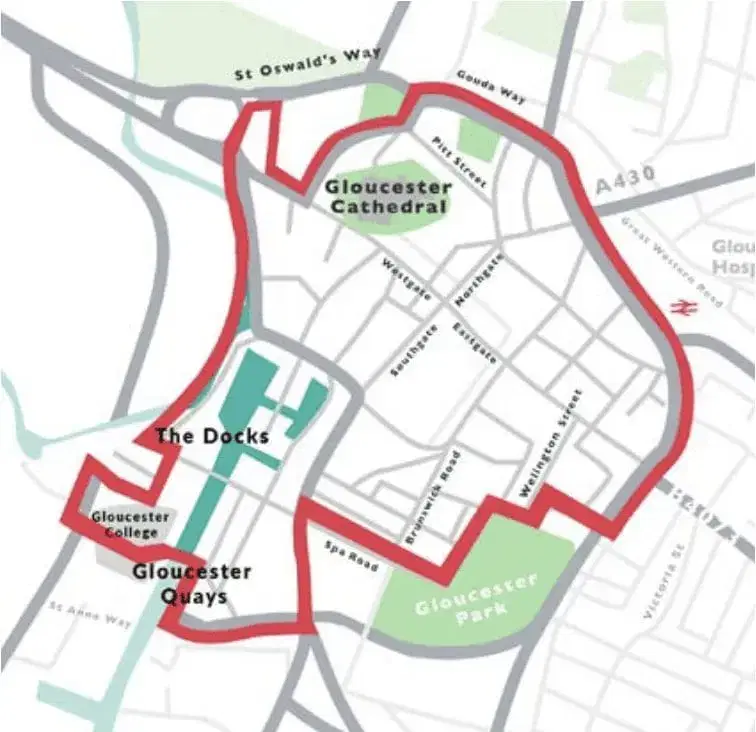
Gloucester Business Improvement District (BID) operates within a defined geographical area, in which non-domestic ratepayers have voted to invest collectively in local improvements that are in addition to those that are already delivered by local statutory bodies.
Gloucester BID has been in operation since 1 July 2017 – with the BID financial year being 1 October to 30 September. Term one was 2017-2022 and in June 2022 another five years of Gloucester BID was voted in by the members, until September 2027.
The BID collects an annual levy from approximately 450 hereditaments each of whom pay an annual levy derived from 1.575% of the rateable value of their premises. Every five years, businesses are able to vote to continue the BID for a subsequent term, based on a set of proposals. The person, registered company or organisation who is the ratepayer for non-domestic rates of a hereditament within the BID area as at the notice of ballot, is entitled to vote.
Each person entitled to vote in the BID ballot shall have one vote in respect of each hereditament in the geographical area of the BID on which non-domestic rates are payable. The ballot has to meet two tests. First, a simple majority of those voting must vote in favour. Second, the aggregate rateable value of the hereditaments of those voting in favour must also be of a majority.
In July 2017, 85.8% of voting businesses voted yes in the first ballot of Gloucester BID, and 87.7% of the Rateable Value voted yes.
In June 2022, 70.8% of voting businesses voted yes and 80.8% of the Rateable Value voted yes.
Gloucester BID is committed to delivering a programme of initiatives that make Gloucester a Safe City, Attractive City and Supported City.
BID FINANCES
- Gloucester Business Improvement District (BID) collects an annual levy from non-domestic ratepayers within the BID area with a rateable value of £10,000 and over and the levy is derived from 1.575% of the rateable value.
- Gloucester City Council (GCC) is required to collect and recover the levy based on the rules for Non-Domestic Rates and can make a charge for the cost of collecting the levy. Regulations on BIDs from ODPM – Statutory Instrument 2004 No2443 BIDS[1] covers this collection.
- The levy is based on the Non-Domestic Rating List as of 1 April in the year of the collection of the levy.
- The levy is invoiced in September and includes a breakdown of income and expenditure for the forthcoming year and a comparison with the previous year.
- The financial summary and forecast for 2025-2026 for Gloucester BID is available here.
BID MANAGEMENT
- Gloucester BID employs a Manager, a Marketing and Engagement Lead and Markting Support.
- The Manager is responsible for regularly reporting to the BID Board of Directors, the BID Manager will be responsible for delivering the BID’s objectives and priorities.
BID GOVERNANCE
- The Board of Directors meet at least six times a year to make strategic decisions.
- Gloucester BID holds regular forum events and invites BID members to attend to discuss upcoming projects and opportunities. See more here
- If you would like to become a Board member please send a letter to the Board and it will be discussed at the next Board meeting.
Please subscribe to the Gloucester BID enews to keep updated on the latest BID projects, services and events. To subscribe, please enter your details in the sign up form on our homepage or contact:
BID DOCUMENTS
- 2025-2026: Summary and Forecast. Insert Included in Levy Bills sent via Gloucester City Centre See Here
- 2024-2025: Summary and Forecast. Insert included in Levy Bills sent via Gloucester City Centre Insert BID 2024-2025
- BID Business Plan 2022-2027
- 2021-2022: Summary and Forecast. Insert included in Levy Bills sent via Gloucester City Council
- Letter sent with summons from Gloucester City Council which includes information on how to pay in instalments
FAQs
What is a BID?
Following a successful renewal ballot, the second five-year term of Gloucester BID started on 1st October 2022 and will run until 31st September 2027.
As a democratically elected, independent body, Gloucester BID enables more than 400 businesses to work collectively to influence and impact on how Gloucester city centre is managed and develops.
We are a Company limited by guarantee Registration No. 10618116 and operate under The Business Improvement Districts (England) Regulations 2004.
How long does a BID term last?
How does a BID Start?
For a BID to go ahead the ballot must be won on two counts: straight majority and majority of rateable value. This ensures that the interests of large and small businesses are protected. There is no minimum turnout threshold.
The ballot is run independently by the local authority. Following a successful renewal ballot in 2022, the second five-year term of Gloucester BID started on 1st October 2022 and will run until 31st September 2027.
How much has been invested into Gloucester so far?
Am I eligible to vote?
How can I reach out to the BID?
Isn't this what my business rates are for?
How do I know if it's working?
If I'm a no, do I still pay?
How is the BID levy calculated?
How is the BID levy spent?
The projects and services which will be delivered during the five-year BID period are agreed and set out in Gloucester BID’s 2022-2027 Business Plan.
Key performance indicators (KPIs) are defined, and performance is monitored by the Gloucester BID Board and respective committees.
The annual budget is approved through the Board of Directors. The Board of Directors receive regular advice regarding the review and evaluation of projects from the management team prior to making further decisions on spend or reprofiling of expenditure.
How are Board Directors elected?
What's the benefit of Gloucester BID?
The City Protection Officers, Gloucester Gift Card, Summer Planters, Public Realm improvements, a place to voice your concerns, city centre wide campaigns, high footfall events and music festival organisation.
City marketing and branding.
Who can see the annual accounts?
What is the levy spend and procurement policy?
Gloucester BID activity is delivered over and above the projects and baselined service levels provided by public agencies including the Local Authority.
The projects and services which will be delivered during the current five-year BID period are agreed and set out in Gloucester BID’s 2022-2027 business plan
Key performance indicators (KPIs) are defined and performance is monitored by the Gloucester BID Board and respective committees.
The annual budget is approved through the Board of Directors.
The Board of Directors receive regular advice regarding the review and evaluation of projects from the management team prior to making further decisions on spend or reprofiling of expenditure.
The annual BID levy payment invoice is accompanied by a billing leaflet outlining what projects and services the BID will be spending the levy on.

E-Newsletters and Communication
Please find below all the past e-newsletters – if you would like to stay up-to-date, subscribe to our mailing list.
LATEST E-NEWSLETTERS 2025-2026
LATEST E-NEWSLETTERS 2024-2025 Year 8
LATEST E-NEWSLETTERS 2023-2024 Year 7
September 27th
September 13th
SAFER CITY September 2nd
September 2nd
August 8th
July 29th
July 18th
July 12th
July 4th
June 25th
May 30th
April 8th
March 27th
March 20th
March 12th
March 5th
February 27th
February 19th
February 12th
February 5th
January 29th
January 22nd
January 15th
January 8th
December 22nd
December 15th
December 6th
November 23rd
October 31st
October 16th
October 6th
October 2nd
LATEST E-NEWSLETTERS 2022-2023 Year 6
LATEST E-NEWSLETTERS 2021-2022 Year 5
LATEST E-NEWSLETTERS 2020-2021 Year 4
OCTOBER 2021
SEPTEMBER 2021
AUGUST 2021
JULY 2021
JUNE 2021
MAY 2021
APRIL 2021
MARCH 2021
FEBRUARY 2021
JANUARY 2021
FOR EARLIER ONES PLEASE EMAIL
Priorites

Business Improvement District Members: Keep up-to-date with the latest information from Gloucester BID. BID members receive regular newsletters about updates and opportunities. If you don't receive our e-newsletters - subscribe today.
MEMBERS OF THE BID BOARD

BECCI ZADAWSKI
CHAIR, BUSINESS OWNER, NORVILLE OPTICIANS

CHRIS NYLAND
VICE CHAIR, MANAGER, NETTL OF GLOUCESTER

JUSTIN HUDSON
VICE CHAIR, BUSINESS OWNER, BUTLERS

KIERON BATES
DIRECTOR OF CAFE RENE AND THE FOUNTAIN

MARIE KIMBER
MANAGER, PRIMARK

OWEN ACLAND
CENTRE MANAGER, GLOUCESTER QUAYS
JASON ROBINSON
SENIOR DESTINATION MANAGER, KING'S QUARTER
MANDY SIBLEY
AREA MANAGER FIG FLEX OFFICES
TOBY WOOLDRIDGE
PROPERTY OWNER
INSPECTOR ASHLEY SHINGLER
GLOUCESTERSHIRE CONSTABULARY
HUGH JOSLYN
BARS MANAGER, HOTEL INDIGO
CLAIRE DOVEY-EVANS
Gloucester City Council - OBSERVER
LUKE LUTMAN
PRESIDENT OF CHAMBER OF COMMERCE
TOBIAS AUSTIN-MILNER
HOWDEN
NADIA FAKHREDIN
GENERAL MANAGER, HOTEL INDIGO
GLOUCESTER BID TEAM

EMILY GIBBON
Gloucester BID Manager

CLAIRE KNIGHT
Marketing and Business Engagement Lead
ISABELLE TOWNSEND
Marketing Assistant
JOHN RILEY
AMBASSADOR COORDINATOR

STEVE LINDSAY MBE
GLOUCESTER CITY SAFE, CPO Manager

NIGEL MORRIS
City Protection Officer

MICHAEL COTTRELL
City Protection Officer

EMMANUEL
City Protection Officer
USEFUL INFORMATION
WHO STARTS THE BID PROCESS?
The BID proposer can be any non-domestic ratepayer, property owner, local authority or other key stakeholder with an interest in the BID area, the idea for a BID will usually come from an existing partnership or group of businesses such as a Town Centre Management group, Chamber of Commerce or business forum, or a Destination Management Organisation In the case of a TBID.
Having an established partnership with a track record of delivery and a common purpose can certainly help when developing and promoting a BID.
DEVELOPING THE BID...
- A BID can only be formed following consultation and a ballot in which businesses vote on a BID Proposal or Business Plan for the area
- The ballot is run by the local authority or outsourced by the local authority to a third party
- All businesses eligible to pay the levy are balloted for a minimum of 28 days
- In the UK, for a BID to go ahead the ballot must be won on two counts: straight majority and majority of rateable value. This ensures that the interests of large and small businesses are protected
- There is no minimum turnout threshold
- Industry Criteria and Guidance Notes are published to support locations during the development phase
INFORMATION SHEETS
BID DOCUMENTS
- The BID Proposal or Business Plan sets out businesses’ priorities for improvements for the area and area services, as well as how the BID will be managed and operated
- This document becomes legally binding once a ballot has been won and becomes the framework within which the BID will operate
- An Operating Agreement is entered into between a BID and their local authority governing how the BID levy monies are collected and administered and passed over to the BID
- BIDs enter into Baseline Agreement with their local authority and other service providers, which specify the level of service provision in the area. These ensure that any services the BID provides are additional
- The list of Street Names covered by the Proposed BID area can be found here.
BID LEVY & FUNDING
- A BID is funded through the BID levy, which is a small percentage of a businesses’ rateable value. The majority of BIDs charge 1% of rateable value, however there are some that have opted for higher levies, particularly in smaller locations with lower rateable values and industrial areas
- Once a ballot is successful the BID levy is mandatory for all eligible businesses. BIDs can choose to exempt certain businesses from paying the levy (and therefore from voting in the BID ballot). Many BIDs exempt the smallest businesses; and some exempt certain business sectors
- BIDs are often successful at attracting funding in addition to the BID levy. They are particularly attractive to public sector grant making bodies due to the private sector match-funding available through the BID levy. Local authorities, property owners, and businesses outside the BID area can all provide additional income for BIDs through voluntary agreements
GOVERNANCE AND MANAGEMENT
- The vast majority of BIDs are not-for-profit companies limited by guarantee
- BIDs set out how they will be governed in their BID Proposal or Business Plan and Company Articles of Association
- Most BIDs are governed by a board made up of BID levy payers representing the BID area
- BID management teams vary with the size, focus and budget of each BID but will generally encompass management, administration, business engagement, marketing and communications and project management
- Performance Measurement
- It is important for BIDs to measure performance to demonstrate the return on investment to levy payers through activities in the area.
- Industry Accreditation is focused on ensuring quality management systems exist within BIDs
RENEWING A BID
QUESTIONS THAT ARE ASKED WHEN CHECKING BID VIABILITY
- Is there a critical mass of private sector support and leadership for the idea?
- Are the businesses involved representative, both in terms of the size and types of businesses?
- Is there wider engagement with the Council and other stakeholders, especially at leadership level?
- What are the major issues?
- How would a BID add value?
- What is the likelihood of positive ballot result?
CONSULTATION CHECKLIST
- Set up a contacts database from the NNDR lists with all businesses in the target area. Include any additional relevant information, e.g. from existing Town Centre Management
- Identify the list of ‘target’ businesses for the survey; try to include:
- Those who would be likely to pay more than say £1,000 in annual levy if the rate was set at 1.5% of rateable value
- Some of the smallest businesses
- Businesses from each sub-area
- Businesses across the spread of key sectors
- Landowners – although they will not pay the levy (unless their properties are empty) they may sit on a future BID board and make – Voluntary contributions for specific projects
- Design the survey to be used in the business consultation – a mix of structured questions (for analysis) plus wider discussion
- Set up an online survey and publicise the link through council and other mailing lists
- Identify local ‘talent’ to target for core group
- Set up core group to test viability and act as local advocates
- Focus on a few local businesses to gauge support and identify the major issues
- Think about identifying the possible levels of any threshold
- Ensure that all businesses consulted receive feedback from the consultation
- Ensure interviewees are senior enough to give a reliable view on behalf of their companies
- Ensure adequate representation from all sectors, including night time economy operators
- Consider other forms of partnerships, perhaps relying on voluntary funding contributions
INVITATION TO TENDER
- Please click here to download our Invitation to Tender document.
THE DEVELOPMENT OF ANY BID WILL FOLLOW THE SAME BROAD STAGES:
- BID proposer consulting with stakeholders including businesses and the local authority to assess and secure support and to agree local needs and priorities
- Establishing governance, control and leadership arrangements
- Scoping the area, assessing feasibility, defining the levy payers and how the levy will be calculated
- Developing a prospectus and business plan and canvassing support
- Balloting potential levy payers
- Delivering the programme, reviewing and developing the BID
- Scoping checklist
THE ROLE OF THE LOCAL AUTHORITY
ARRANGING AND PAYING FOR THE BALLOT
COLLECTING THE LEVY
PROVIDING MANY OF THE SERVICES IN THE BASELINE AGREEMENT
ENSURING THE BID PROPOSAL IS ALIGNED WITH LOCAL AUTHORITY POLICIES AND THAT OFFICERS ARE AWARE OF THE LEVEL OF SUPPORT EXPECTED FROM THEM
HAVE SOMETHING TO OFFER?
If you'd like to offer your products or services as a benefit to BID members, please submit details so we can put to the Board.
View & Download Business Plan below.
